Friday, June 13, 2014

Yuganta – End of an Epoch By Iravati Karve

Yuganta – End of an Epoch  
By Iravati Karve
Genre: Mythology
SIZZLER

The Book Club Rating : 5 Stars

Yuganta studies the principal, mythical-heroic figures of the Mahabharata from historical, anthropological and secular perspectives. The usually venerated characters of this ancient Indian epic are here subjected to a rational enquiry that places them in context, unravels their hopes and fears, and imbues them with wholly human motives, thereby making their stories relevant and astonishing to contemporary readers. Irawati Karve, thus, presents a delightful collection of essays, scientific in spirit, yet appreciative of the literary tradition of the Mahabharata. She challenges the familiar and formulates refreshingly new interpretations, all the while refusing to judge harshly or venerate blindly.

Irawati Karve (1905 1970) was born in Burma and educated in Pune. A Master s degree in Sociology from Bombay in 1928 and a Doctoral degree in Anthropology from Berlin in 1930 marked the onset of a long and distinguished career of pioneering research. She wrote in both English and Marathi, on academic subjects as well as on topics of general interest, and thus commanded an enviably wide circle of readership. Whether through her Hindu Society: An Interpretation, a scholarly treatise in English, or through Yuganta: The End of an Epoch, her study in Marathi of the characters and society in the Mahabharata, we obtain ample illustration of the range and quality of Irawati Karve s mind.

Buy at: Amazon.in | Amazon.com


I read Yuganta when I was barely in my teens. To a large extent this book has influenced my perceptions about Mahabharata.

Iravati Karve’s Yuganta – End of an Epoch is not a rehash of the epic. It is an in-depth character analysis of prominent characters and controversial subjects in the great epic of Mahabharata.

Stripping the trappings of myth, legend and imagination, the author presents us the bare truth, as she perceives it. Take Bhishma for instance. One of the strongest characters who virtually safeguards the Kuru empire, doing his duty regardless of the result. A man of unbendable will, virtue and irreproachable character. But to what avail?  He gave up the right to his father’s kingdom and watched his step brothers ascend the throne. He is the grandsire of Kuru empire yet his life was an empty paradise. He couldn’t control Duryodhana and his brothers, he was virtually ineffective in the sabha room when Draupadi is disrobed and in the end he couldn’t stop the war. What did he achieve in the end?


Reviewed by Sundari Venkatraman


Publisher: Orient Longman; 2nd Revised edition edition (19 July 2006)


The Magic Flute
By K.M Munshi
Genre: Mythology
SIZZLER

The Book Club Rating : 5 Stars

Krishnavatara is a 7-volume reconstruction of Krishna's life and adventures by weaving a romance around him. Wise ad valorous, he was, loving and loved, far-seeing and yet living for the moment, gifted with sage-like detachment and yet intensely human; the diplomat, the sage and the man of action with a personality as luminous as that of a divinity. The first part, which ends with the death of Kamsa has been named The Magic Flute, for it deals with his boyhood associated with the flute, which hypnotized men, animals and birds alike, sung with such loving tenderness y innumerable poets. The second volume, which ends with Rukmini Haran, is named as The Wrath of an Emperor, as the central theme is the successful defiance by Sri Krishna of Jarasandha, the Emperor of Magadha. The third part is entitled The Five Brothers and ends with Draupadi's Swayamvara. The Fourth is titled The Book of Bhima, Fifth part The Book of Satyabhaama, the sixth volume The Book of Vyaasa, the Master. The seventh and concluding volume, incorporating 7th part and unfinished 8th part, is titled The Book of Yudhishthira.


Buy at: Amazon.in 


Krishnavatra series by K.M. Munshi were some of the earliest books that I read. My passion for reading was kick-started by these books. I borrowed them from my grandfather who was only too happy to lend them to someone who shared his own passion for reading.

Munshi has humanized Krishna as much as possible in these series but yet has maintained an aura of mystique that will make you adore his Godliness while it is juxtaposed with normal human-like behaviour.

The first part Magic Flute is where he gives you the wonderful background story of Krishna’s ancestors and we learn about Yadavas in general and their very many clans. Krishna and his elder brother Balarama are spirited away from Mathura right after their birth and the miraculous happenings that aid their escape are toned down.

Krishna grows up in Gokul and the so-called demons and asuras that Kamsa sends in to kill him turn out to be assassins. I was particularly touched by Putana’s death and her redemption and the guilt that she felt for killing scores of innocent children.


Reviewed by Sundari Venkatraman


Publisher: Bharatiya Vidya Bhavan/Mumbai/India; 11th reprint edition (19 August 2012)


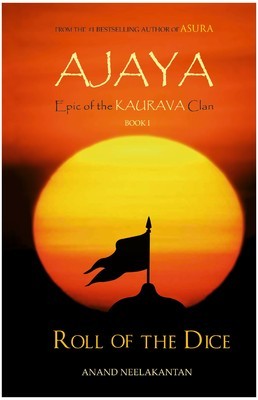
Ajaya: Roll Of The Dice By Anand Neelakantan

Ajaya: Roll Of The Dice
By Anand Neelakantan
Genre: Mythology
OK

The Book Club Rating : 2 Stars

THE MAHABHARATA ENDURES AS THE GREAT EPIC OF INDIA. But while Jaya is the story of the Pandavas, told from the perspective of the victors of Kurukshetra; Ajaya is the narrative of the ‘unconquerable’ Kauravas, who were decimated to the last man. At the heart of India’s most powerful empire, a revolution is brewing. Bhishma, the noble patriarch of Hastinapura, is struggling to maintain the unity of his empire. On the throne sits Dhritarashtra, the blind King, and his foreign-born Queen – Gandhari. In the shadow of the throne stands Kunti, the Dowager-Queen, burning with ambition to see her firstborn become the ruler, acknowledged by all. And in the wings: Parashurama, the enigmatic Guru of the powerful Southern Confederate, bides his time to take over and impose his will from mountains to ocean. Ekalavya, a young Nishada, yearns to break free of caste restrictions and become a warrior. Karna, son of a humble charioteer, travels to the South to study under the foremost Guru of the day and become the greatest archer in the land. Balarama, the charismatic leader of the Yadavas, dreams of building the perfect city by the sea and seeing his people prosperous and proud once more. Takshaka, guerilla leader of the Nagas, foments a revolution by the downtrodden as he lies in wait in the jungles of India, where survival is the only dharma. Jara, the beggar, and his blind dog Dharma, walk the dusty streets of India, witness to people and events far greater than they, as the Pandavas and the Kauravas confront their searing destinies. Amidst the chaos, Prince Suyodhana, heir of Hastinapura, stands tall, determined to claim his birthright and act according to his conscience. He is the maker of his own destiny – or so he believes. While in the corridors of the Hastinapura palace, a foreign Prince plots to destroy India. And the dice falls

Buy at: Amazon.com | Amazon.in


Let me begin this review by congratulating Anand Neelkantan for attempting to give a voice to those who have been derided as evil, selfish and self-centered for centuries. Ajaya is the story of Duryodhana, the evil crown prince of Mahabharata. All our life we have heard about the atrocities that this prince committed against his own cousin and the great war that he started. With this book, the author has attempted to present the Mahabharata from Duryodhana’s point of view.

The book begins with the destruction of Gandhara and introduction of Shakuni and Gandhari. Bhishma wages a war on their land to get Gandhari as a bride for his blind nephew. Incensed with rage and pain, Shakuni swears vengeance even at a tender age.

And then the story proceeds to introduce Suyodhana (his birth name that got distorted to Duryodhana according to local legends) and his siblings and the indomitable Bheema and his brothers. Shakuni is seen indulging in some plot against the Kurus, while Vidura the wise, tries to warn Bhishma about it.

Reviewed by Sumeetha Manikandan


Publisher: Leadstart Publishing Pvt Ltd; First edition (December 11, 2013)


The Krishna Key by Ashwin Sanghi

The Krishna Key
By Ashwin Sanghi
Genre: Mythology
Okay

The Book Club Rating : 2 Stars

Five thousand years ago, there came to earth a magical being called Krishna, who brought about innumerable miracles for the good of mankind. Humanity despaired of its fate if the Blue God were to die but was reassured that he would return in a fresh avatar when needed in the eventual Dark Age—the Kaliyug.

In modern times, a poor little rich boy grows up believing that he is that final avatar.

Only, he is a serial killer.

In this heart-stopping tale, the arrival of a murderer who executes his gruesome and brilliantly thought-out schemes in the name of God is the first clue to a sinister conspiracy to expose an ancient secret—Krishna’s priceless legacy to mankind.

Historian Ravi Mohan Saini must breathlessly dash from the submerged remains of Dwarka and the mysterious lingam of Somnath to the icy heights of Mount Kailash, in a quest to discover the cryptic location of Krishna’s most prized possession. From the sand-washed ruins of Kalibangan to a Vrindavan temple destroyed by Aurangzeb, Saini must also delve into antiquity to prevent a gross miscarriage of justice.

Ashwin Sanghi brings you yet another exhaustively researched whopper of a plot, while providing an incredible alternative interpretation of the Vedic Age that will be relished by conspiracy buffs and thriller-addicts alike

Buy at: Amazon.in | Amazon.com


 humongous amount of research has gone into this book. So much so, that the way it’s been presented makes the reader wonder whether the book is a work of fiction at all. It so reminded me of the novel ‘Prizes’ by Erich Segal. Prizes was like reading a physics text book. The author had obviously done a lot of research and was using his knowledge. That’s fair to him. But what about the one who is looking forward to reading a work of fiction? And then finding so much knowledge crammed down one’s throat. I am sure there is a subtle way of doing this. In fact, I have garnered a lot of my knowledge through reading fiction. The presentation counts, doesn’t it?

There is a point at which Professor Ravi Mohan Saini’s student Priya tells him to stop his boring lectures. She could not be more right. He does go on and on about history and mythology. I love both the subjects, but definitely not the way they have been packaged in this book.

How could the professor come up with his answer in a jiffy, every time? He guesses most of them. While they are based on his knowledge, it’s still strange the way he keeps going by hunches and the reader is given the impression that he comes up trumps each time. Everything is happening in Ravi Mohan Saini’s head. Difficult to swallow!

I have read Ashwin Sanghi’s (as Shawn Haigins) The Rozabal Line. Well researched, fast paced, logical, fascinating and beautifully written. It’s difficult to accept that the same author has come up with The Krishna Key.


Reviewed by Sundari Venkatraman


Publisher: Westland Limited (24 August 2012)


Princess by Jean Sasson

Princess
By Jean Sasson
Genre: Historical Fiction
SCORCHING

The Book Club Rating : 4 Stars


Sultana is a Saudi Arabian princess, a woman born to fabulous, uncountable wealth. She has four mansions on three continents, her own private jet, glittering jewels, designer dresses galore. But in reality she lives in a gilded cage. She has no freedom, no control over her own life, no value but as a bearer of sons. Hidden behind her black floor-length veil, she is a prisoner, jailed by her father, her husband, her sons, and her country.Sultana is a member of the Saudi royal family, closely related to the king. For the sake of her daughters, she has decided to take the risk of speaking out about the life of women in her country, regardless of their rank. She must hide her identity for fear that the religous leaders in her country would call for her death to punish her honesty. Only a woman in her position could possibly hope to escape from being revealed and punished, despite her cloak and anonymity.Sultana tells of her own life, from her turbulent childhood to her arranged marriage--a happy one until her husband decided to displace her by taking a second wife--and of the lives of her sisters, her friends and her servants. Although they share affection, confidences and an easy camaraderie within the confines of the women's quarters, they also share a history of appaling oppressions, everyday occurrences that in any other culture would be seen as shocking human rights violations; thirteen-year-old girls forced to marry men five times their age, young women killed by drowning, stoning, or isolation in the women's room, a padded, windowless cell where women are confined with neither light nor conversation until death claims them.By speaking out, Sultana risks bringing the wrath of the Saudi establishment upon her head and te heads of her children. But by telling her story to Jean Sasson, Sultana has allowed us to see beyond the veils of this secret society, to the heart of a nation where sex, money, and power reign supreme

Buy at: Amazon.in | Amazon.com


I got curious when I saw an office colleague having this book. I borrowed it from her when she told me that it was ‘awesome’. It took me less than two days to complete the book as it flowed pretty fast.

The book follows the real life story of Princess Sultana Al Sa’ud of Saudi Arabia – the name changed for maintaining the lady and her family’s privacy. Jean Sasson has narrated the story in first person in the voice of the Princess herself.

Princess Sultana talks about her life from childhood, beginning at the age of four. She speaks about the way the women of Saudi Arabia, including those in the royal households, are dominated over completely by the men. Even her father’s driver Omar appears to have had more authority in their home than her mother or Sultana and her sisters.

Sultana’s brother Ali is given so much importance that the young girl believed that he was God. It is after her mother sets her right does Sultana understand that Ali was treated the way he was because he is the SON of the house and for no other reason.


Reviewed by Sundari Venkatraman


Publisher: RHUK (1 October 2004)


The Oath of Vayuputras by Amish Tripathi

The Oath of Vayuputras
By Amish Tripathi
Genre: Mythology
SCORCHING

The Book Club Rating : 4 Stars

ONLY A GOD CAN STOP IT. 

Shiva is gathering his forces. He reaches the Naga capital, Panchavati, and Evil is finally revealed. The Neelkanth prepares for a holy war against his true enemy, a man whose name instils dread in the fiercest of warriors. 

India convulses under the onslaught of a series of brutal battles. It's a war for the very soul of the nation. Many will die. But Shiva must not fail, no matter what the cost. In his desperation, he reaches out to the ones who have never offered any help to him: the Vayuputras. 

Will he succeed? And what will be the real cost of battling Evil? To India? And to Shiva's soul? 

Discover the answer to these mysteries in this concluding part of the bestselling Shiva Trilogy

Buy at: Amazon.in 


I had bought the book about 45 days ago. I started reading it almost immediately. To begin with, it took me a while to recall the characters – apart from Shiva and his family, of course – and get my teeth into the book.

It was mighty slow going as the story turned out to be quite lethargic. I had not quite expected this considering that I almost rushed through reading The Immortals of Meluha and The Secret of the Nagas.

The first two books were too interesting and absorbing for words. I had to read the first few chapters of The Oath of the Vayuputras over a few weeks. Then the magic unfolded suddenly. The story got back on track and became appealing once again.

From that point on, the book moved fast and despite the blood and gore of war, I was hooked to the book till the end. Congratulations Amish! You have made history. Truly amazing work - The Shiva Trilogy!

The Lament of the Blue Lord is the chapter that truly touched my heart. I love you Shiva! 


Reviewed by Sundari Venkatraman


Publisher: Westland (13 August 2013)


The Secret of The Nagas By Amish Tripathi

The Secret of The Nagas
By Amish Tripathi
Genre: Mythology
SCORCHING

The Book Club Rating : 5 Stars

4000 years ago, He was just a man. 

The hunt is on. The sinister Naga warrior has killed his friend Brahaspati and now stalks his wife Sati. Shiva, the Tibetan immigrant who is the prophesied destroyer of evil, will not rest till he finds his demonic adversary. His vengeance and the path to evil will lead him to the door of the Nagas, the serpent people. Of that he is certain. 

The evidence of the malevolent rise of evil is everywhere. A kingdom is dying as it is held to ransom for a miracle drug. A crown prince is murdered. The Vasudevs Shivas philosopher guides betray his unquestioning faith as they take the aid of the dark side. Even the perfect empire, Meluha is riddled with a terrible secret in Maika, the city of births. Unknown to Shiva, a master puppeteer is playing a grand game. 

In a journey that will take him across the length and breadth of ancient India, Shiva searches for the truth in a land of deadly mysteries only to find that nothing is what it seems. 

Fierce battles will be fought. Surprising alliances will be forged. Unbelievable secrets will be revealed in this second book of the Shiva Trilogy, the sequel to the #1 national bestseller, The Immortals of Meluha

Buy at: Amazon.in 


Well, you have to read the book to find out. I was totally zapped. I went back to my college days (that of course, was eons ago) when I used to stay up late into the night, reading books that I simply could not put down. Somehow, that trend had stopped as I took on more responsibilities as a wife, mother and a full-time employee. After two-and-a-half decades, I stayed up till 3 am to complete the book as I just could not put it down without finishing it.

Before reading the book, I seriously wondered what more the author could have to astonish, amaze or hold one’s interest. It seemed that he had said it all in the first book.

Reading the book made me understand differently. It just shows the wealth of imagination Amish has and his story-telling skills don’t waver at all as he fascinates us with more characters – will not mention names here as the book has been out for barely a week – and incidents that are spellbinding.

It’s amazing the way Amish weaves characters and incidents from mythology along with perfectly acceptable, workable incidents in everyday life in 1900 BC and presents the perfect product, not a thread out of place. Swadweep, Brangaidai, Dandakaranya Forests and Panchavati spring to life in front of our eyes under the author’s able guidance.


Reviewed by Sundari Venkatraman


Publisher: Westland Books Pvt. Ltd. (1 April 2012)